Introduction

What happens when a web agency stops building websites and starts building products?
GiverLink started as a problem that most fundraising organisations live with so long they stop noticing it: the platform sitting between them and their donors is taking a cut of every donation. Five to eight percent is common. For a charity golf day raising $500,000, that's $25,000–40,000 leaving the cause before it even arrives.
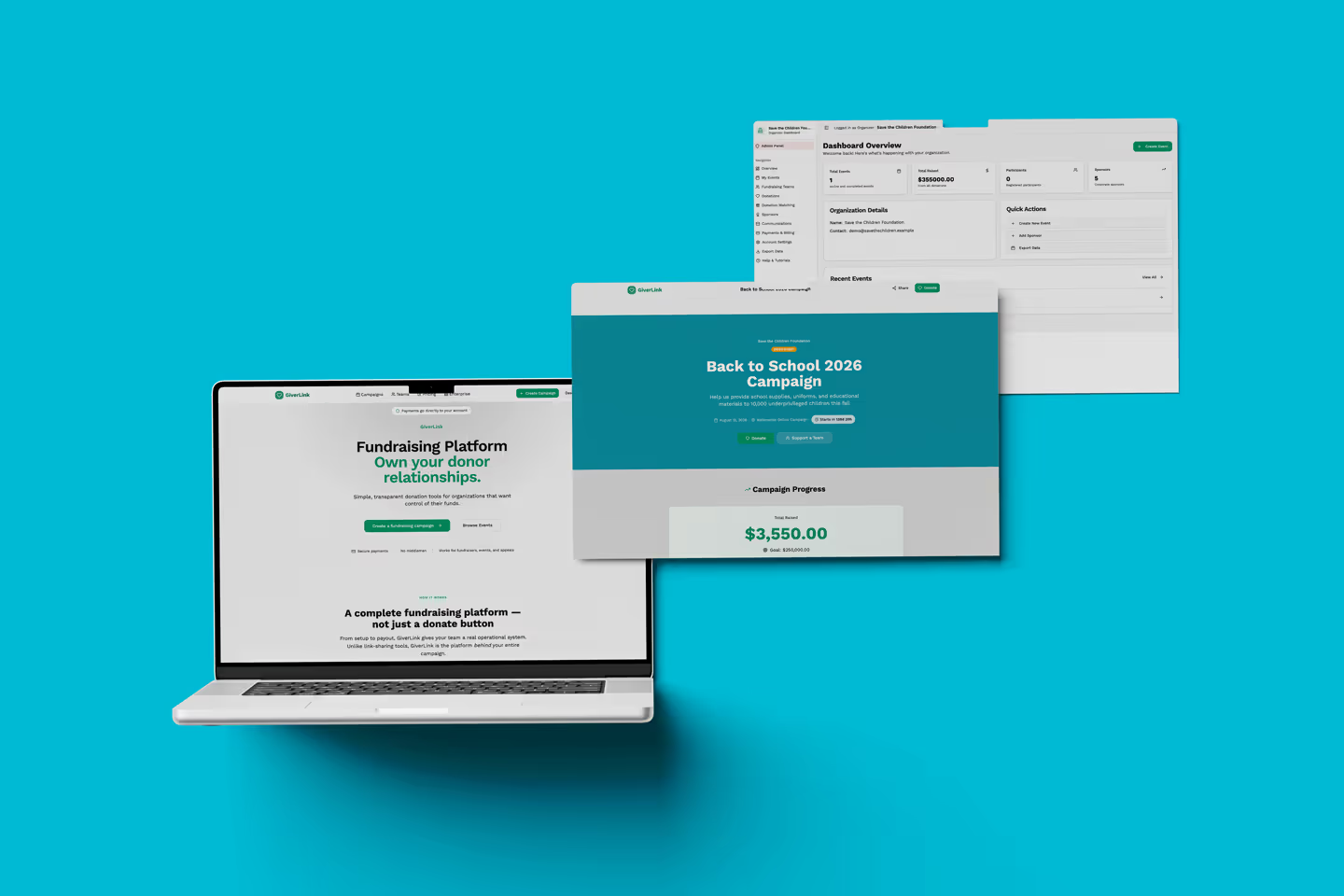
BrandingLab built GiverLink to change that model. GiverLink is a modular fundraising SaaS platform — campaign pages, team fundraising, sponsor tier management, live dashboards, Stripe Connect and PayFast payments — where donations flow directly from the donor's card to the organiser's own connected account. The platform earns revenue through flat annual licence fees. Not a single cent comes from transaction commissions.
The project was also a deliberate test of what vibe coding can actually deliver. GiverLink was built using Lovable — a tool that generates full-stack applications from natural language specifications — on a six-week runway, without a traditional engineering team. The result is a production-ready SaaS platform running React 18, TypeScript, Tailwind CSS, Supabase, and Stripe Connect, serving nonprofits, schools, sports clubs, and faith-based organisations.
Project: GiverLink — modular fundraising SaaS platform
Built by: BrandingLab (product strategy, architecture, AI-assisted development)
Tech stack: React · TypeScript · Tailwind CSS · Supabase · Stripe Connect
Development tool: Lovable
Duration: 6 weeks from concept to production
Live: giverlink.com
Who is GiverLink for?
GiverLink was built for three audiences that share the same underlying problem. Nonprofits, schools, and faith communities — shuls, churches, mosques — that run annual appeals, seasonal drives, and ticketed events but have been paying percentage-based platform fees that quietly erode what they raise. Sports clubs and charity events — golf days, gala dinners, fun runs — that need ticketing, team pages, sponsor management, and live leaderboards consolidated into a single operational system rather than spread across four different tools. And corporate CSR teams running employee giving programmes who need the dashboard, reporting, and compliance documentation that their CFO and board actually require.
The connecting thread is that all three were being served by a fundraising technology market that had structured its business model around their transactions rather than their outcomes. GiverLink's positioning — "own your donor relationships" — is a direct answer to that.
Challenge
What is actually wrong with existing fundraising platforms?The fundraising technology landscape is dominated by platforms that position themselves between donors and causes and take a percentage for the privilege. The fee problem is structural: Classy charges 5–8% on every transaction. GoFundMe takes 2.9% plus tips. Givebutter runs tip-based fees that can reach 8%. For organisations raising meaningful amounts, these are not small numbers.
A fundraiser raising $500,000 through Classy pays $25,000–40,000 in platform fees before payment processing. That money was donated to a cause. It left the donor's account directed at that cause. The platform intercepted it in transit. GiverLink's model — flat annual licence, zero transaction commission — changes those economics entirely.
The control problem runs alongside the fee problem. Most platforms hold donor funds before disbursing them to the organiser. This creates cash-flow delays, reduces financial transparency, and means the organiser doesn't truly own the donor relationship or the donor data. Your donor history lives in the platform's database first. When you leave, it stays there.
The third problem is complexity at scale. Running a real fundraising event — a charity golf day with 120 players across 30 teams, twelve sponsors across three tiers, a donation matching programme, and a live leaderboard — requires either significant spreadsheet management or a platform purpose-built for that workflow. Enterprise tools like Blackbaud and Salesforce Nonprofit Cloud exist, but they require dedicated staff, lengthy onboarding, and five-figure contracts. Small-to-mid-size organisations — schools, churches, community sports clubs — need enterprise-grade infrastructure at community-organisation pricing.
The competitor comparison
BrandingLab mapped the competitive landscape before writing a single line of specification. The table below shows what GiverLink was designed to displace:
PlatformPricing modelTransaction feeDirect payouts
GiverLink
Flat annual licence0%Yes (Stripe Connect)Classy% of donations5–8%NoGoFundMe Pro% of donations2.9% + tipsNoGivebutterTip-based0–8%NoDonorbox% of donations1.5–4%No
The brief was clear: build a platform that gives organisers direct control of their funds, eliminates percentage-based fees, and consolidates event management, team fundraising, sponsor coordination, and donor communications into a single tool. Every architectural decision that followed traced back to this brief.
Approach
Architecture first — every product decision flowed from three principles
The most consequential decisions in a SaaS product are architectural. Get them wrong and you build on sand. Three principles defined GiverLink's architecture before any code was written.
Payments never flow through GiverLink. Every donation goes directly from donor card to the organiser's connected Stripe account via Stripe Connect's direct-charge model. GiverLink's platform fee is collected separately through the annual licence — never deducted from donations. For South African organisations, PayFast provides the same direct-deposit philosophy with local payment method support: EFT, SnapScan, Mobicred. This was a philosophical decision as much as a technical one, and it simplified the regulatory and compliance picture significantly. GiverLink is a software platform, not a payment intermediary.
Multi-tenancy from day one. GiverLink needed to serve a small community organisation running one annual appeal and a corporate enterprise running thirty simultaneous campaigns without changing the underlying platform. The Supabase data model — built on PostgreSQL with Row-Level Security — was designed to support this from the first line of specification, not retrofitted after the fact.
The campaign as the primary unit of organisation. A campaign in GiverLink contains events, teams, sponsorship structures, donation matching, and progress tracking as composable elements rather than separate products. A simple donation page and a complex multi-team fundraising event live on the same platform. The simple use case is not cluttered by complexity it doesn't need.
The modular feature set
GiverLink was architected as a modular SaaS platform, with each capability designed as an independent module activatable per event:
- Event Management — Branded event microsites with registration, ticketing, and attendee tracking
- Team Fundraising — Team pages with individual share links, progress bars, and real-time leaderboards
- Sponsor Management — Gold, Silver, Bronze tier packages with logo placement, banner positioning, and ROI tracking
- Donation Engine — Individual and team-attributed donations with matching campaign capabilities and automatic multiplier calculations
- Communications Hub — Template-based email campaigns with delivery tracking and recipient segmentation
- Real-Time Dashboard — Live donation feeds, team standings, and fundraising progress for both organiser and public views
- Tax Receipts — IRS-compliant certificates (and South African Section 18A receipts) auto-generated on every confirmed donation
What vibe coding actually looks like in practice
GiverLink was built using Lovable, which generates React and Supabase applications from natural language specifications. The workflow looks less like writing code and more like product management: define a feature precisely, review what the AI builds, identify the gaps between specification and output, refine the specification, iterate. The AI handles the syntax. The builder handles architecture decisions, edge cases, and judgement calls about what the product should and should not do.
The technical stack that emerged: React 18 and TypeScript on the frontend, Tailwind CSS for styling, Framer Motion for interactions, Supabase for the PostgreSQL database, authentication, edge functions, and real-time subscriptions, Stripe Connect for global payments, PayFast for South African payments, Vite for build tooling, and React Query for server state management.
Six weeks from the first specification to a production multi-tenant platform with this feature set would not have been possible through conventional development. The AI handled code generation. The time investment was in specification clarity, architecture decisions, integration testing, and debugging the edge cases that AI-generated code inevitably produces when it encounters scenarios the specification did not anticipate. The limiting factor was never code generation speed. It was always product clarity.
Pricing designed around the mission, not the platform
GiverLink's pricing reflects its positioning as a technology agent rather than a financial intermediary:
- Pilot — $49 per event, no monthly commitment. For one-off fundraisers, school events, community golf days
- Standard — $199 per year, up to 6 events, full feature access. For faith communities and clubs with regular fundraising calendars
- Pro — $499 per year, unlimited events, priority support, advanced analytics
- Enterprise — $10,000 per year, custom SLA, dedicated account manager, white-label options, CRM/ERP integrations
At every tier, 0% of donations are taken by the platform. The economics that would have paid Classy $25,000 on a $500,000 event stay entirely with the cause.
Feedback
Early adopter results
GiverLink launched with a pilot programme offering zero platform fees for the first cohort of three to five organisations in exchange for real-world testing, feedback, and direct input on the product roadmap. The early results from those conversations confirmed the platform's core value proposition.
"GiverLink eliminated the spreadsheet chaos we used to deal with every golf day. Now our team fundraising is transparent and donors love seeing their impact in real-time."
— Sarah Mitchell, Development Director, Hope Foundation
"We raised 40% more than last year because participants could easily share their fundraising pages. The Stripe integration meant funds hit our account within days."
— James Chen, Events Manager, City Youth Sports
"Our corporate giving program finally has the professional platform it deserves. Team competitions drove incredible engagement across all our offices."
— Amanda Rodriguez, CSR Lead, TechForward Inc.
Key outcomes
- 0% transaction fees — 100% of donations reach the organiser's account
- 40% increase in fundraising for early adopters versus the previous year
- Real-time dashboards and team leaderboards drive donor engagement during live events
- Automated tax certificates eliminate post-event administrative burden
- Direct Stripe payouts — funds settle in 2–3 business days
What this project demonstrates about BrandingLab
GiverLink changes the profile of what BrandingLab is. For the past three years, BrandingLab has been an accredited Webflow partner building marketing sites and digital presences for B2B companies. GiverLink is evidence that the capability set extends further: product strategy, SaaS architecture, AI-assisted development, and the product thinking required to turn a market gap into a working platform in six weeks.
The vibe coding methodology is not a shortcut. It requires more product clarity upfront than conventional development does — the AI will build exactly what you specify, including your specification errors. What it offers in return is a compression of the time between product vision and working software that changes what a single founder or small team can ship in a meaningful timeframe. BrandingLab used it to build a real product at production quality. The right clients will recognise what that means for their own ambitions.
FAQ
Does GiverLink hold donor funds?
No. GiverLink operates as a technology agent. Donations flow directly from the donor's card to the organiser's connected Stripe account via Stripe Connect's direct-charge model. GiverLink never touches the money. For South African organisations using PayFast, funds settle directly into the organiser's merchant account on the same principle.
What is vibe coding and how was it used to build GiverLink?
Vibe coding is building software using AI development tools — in GiverLink's case, Lovable — where the product is specified in natural language and the AI generates working full-stack code. The builder's role shifts from writing syntax to making architecture decisions, reviewing AI output, and iterating on specifications. GiverLink was built this way on React 18, TypeScript, Supabase, and Stripe Connect — from concept to production platform in six weeks.
Can BrandingLab build a SaaS product for my business?
Yes — GiverLink is the proof of concept. BrandingLab can take a clear product brief, make the architecture decisions, drive the AI-assisted development process using Lovable, and deliver a production-ready SaaS application. The ideal brief is one where the founder has strong domain knowledge about the problem they're solving and can specify what the product needs to do with precision. The AI handles the code. BrandingLab handles everything else.
How does GiverLink generate revenue if it takes 0% of donations?
Through flat annual licence fees and optional per-event charges. The Pilot plan starts at $49 per event. Standard is $199 per year for up to 6 events. Pro is $499 per year for unlimited events. Enterprise is $10,000 per year with custom SLA and white-label options. Platform revenue never comes from donor transactions.
Does GiverLink issue tax receipts?
Yes. GiverLink auto-generates IRS-compliant tax certificates immediately after every confirmed donation, sent directly to the donor with the organiser's name and registration details. South African Section 18A receipts are also supported. This is included at every pricing tier — it is not an add-on. For faith-based and non-profit organisations where donor receipt compliance is a regulatory requirement, this removes a significant post-event administrative burden.
Can multiple team members manage an event?
Yes. GiverLink supports role-based access with organiser seats, so committees can collaborate on event setup, sponsor management, and donor communications without sharing a single login. Each seat gets scoped permissions appropriate to their role in the campaign.