Webflow has been adopted by over 1.3 million designers, and the educational resources available to learn the platform have grown alongside that adoption. YouTube has become one of the most valuable learning environments for Webflow practitioners, with a handful of channels consistently delivering education that moves the needle.
Three channels stand out above the rest for different reasons — and together, they cover the full spectrum from foundational skills through advanced techniques to the business of running a Webflow practice.
Flux Academy — Ran Segall
Flux Academy is led by Ran Segall, one of the earliest Webflow adopters and a practitioner who combines genuine pedagogical skill with years of professional design experience. The channel is not purely tutorial-focused — it integrates design thinking, client communication, and creative process alongside technical instruction.
What makes Flux distinctive is the emphasis on the principles behind the decisions, not just the mechanics of implementation. Ran's teaching approach means you leave not just knowing how to do something but understanding why you'd make that decision in a professional context.
The content covers regular video uploads spanning beginner through advanced topics, and Flux Academy offers an extensive Webflow web design course for practitioners who want structured learning. New videos publish Monday, Wednesday, and Friday.
Best for: Designers who want to develop professional-level Webflow capability with a strong conceptual foundation.
Finsweet — Joe Krugs and Team
Finsweet approaches Webflow from a different angle. Rather than structured curriculum, the channel focuses on discovering what's possible — finding creative solutions to platform limitations, pushing the boundaries of what Webflow can do, and sharing those discoveries with the community.
Finsweet is responsible for the Client First system, a widely adopted CSS class naming methodology that establishes consistent, scalable architecture for Webflow projects. The Client First approach has become standard practice for many serious Webflow practitioners, and understanding it is valuable even if you adapt it to your own conventions.
The channel covers both highly technical topics for experienced practitioners and foundational content for those starting out. The business side of web design — scaling a practice, acquiring clients, building recurring revenue — also features alongside technical content.
Content publishes Tuesday and Thursday.
Best for: Practitioners who want to push technical boundaries and understand the systems (like Client First) that underpin professional Webflow development at scale.
Payton Clark Smith — Agency Business and SEO
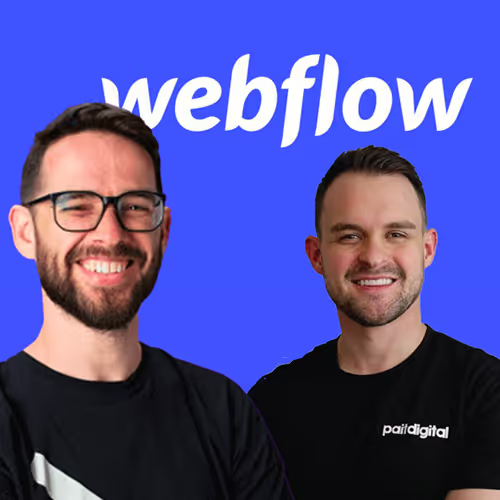
Payton Clark Smith offers a perspective that's underrepresented in most technical education channels: what it's actually like to run a Webflow agency. The weekly vlogs cover client acquisition, project management, business development, and the realistic ups and downs of agency work — alongside technical content and SEO-focused education.
For practitioners who want to build a sustainable Webflow practice rather than just develop platform skills, Payton's content addresses the questions that technical tutorials don't: how to get clients, how to price projects, how to handle difficult client situations, and how to build a business rather than just a skillset.
The SEO-focused course addresses the intersection of Webflow development and search performance — particularly relevant for practitioners whose clients care about organic visibility.
Best for: Webflow practitioners who want to develop agency business skills alongside platform capabilities.
Other Notable Channels
The Webflow education ecosystem extends well beyond these three. Webflow's own YouTube channel provides official documentation and feature announcements. Timothy Ricks covers advanced interactions and GSAP animation with particular depth. Nelson Sakwa focuses on freelancing and business development from a perspective relevant to newer practitioners.
The community around Webflow is genuinely generous with knowledge — a reflection of a platform where practitioners benefit from shared learning rather than hoarding techniques as competitive advantage. Start with the three channels above and expand from there as your specific interests develop.